We Are Different And We Are Similar

Universals, Commonality, Diversity and Variation In Parenting and Child Development

2026-03-18

How To Navigate This Presentation

  • Use the ⬅️ ➡️ keys to move through the presentation.
  • Press o for panel overview.
  • Press for menu.

Acknowledgements

  • Collaborators:
    • Professor Julie Ma
    • Professor Yoonsun Han
    • Dr. Kaitlin Ward
  • Members of the Global Families Project
  • IPUMS
  • NICHD

The Scope of the Issue

  • UNICEF considers children globally to be in crisis: political violence, climate change, and poverty affect many children (UNICEF 2024a, 2024b).
  • In this time of crisis, parenting is one crucial area of focus.
  • According to UNICEF data, \(\frac{1}{3}\) of children are subject to physical punishment (Ward et al. 2023); \(\frac{2}{3}\) to some form of violent punishment (UNICEF 2024a).
  • In a review of 50 years of literature on physical punishment, Gershoff and Grogan-Kaylor (2016) connect physical punishment to poor mental health outcomes, and other poor outcomes over the life course. Ward et al. (2023) examines the relationship of multiple forms of parental discipline to child outcomes.

Are We Similar? Are We Different?

positive parenting

positive parenting

countries in MICS data

countries in MICS data

Both Universals and Variation Are Important

“Despite the incredible diversity existing among and within human cultures, there are many phenomena that occur regularly in all known societies. These commonalities, or universals, while deriving in part from human nature, may also have specific social, cultural, and systemic sources. We need to develop a working understanding of these universals so that we might advance legitimate, empirically based human science set on creating knowledge that is politically relevant to fostering real solutions to the problems that complicate human co-existence in the Age of the Anthropocene.” (Antweiler 2016)

Highlighting Commonalities May Promote Intergroup Attitudes And Solidarity

Hanel et al. (2019) cite research suggesting that ‘highlighting similarities between groups improves interpersonal and intergroup attitudes.’ Others have argued that ‘build[ing] bonds of commonality across our differences’ might be an impetus for social transformation (Hunt-Hendrix and Taylor 2024).”

The Argument Of This Presentation

  • Families, parents and children experience an incredible diversity of circumstances.
  • Parents engage in parenting behaviors with consequent diversity, though with some surprising similarities.
  • The associations of parenting with child outcomes are surprisingly consistent.

Data

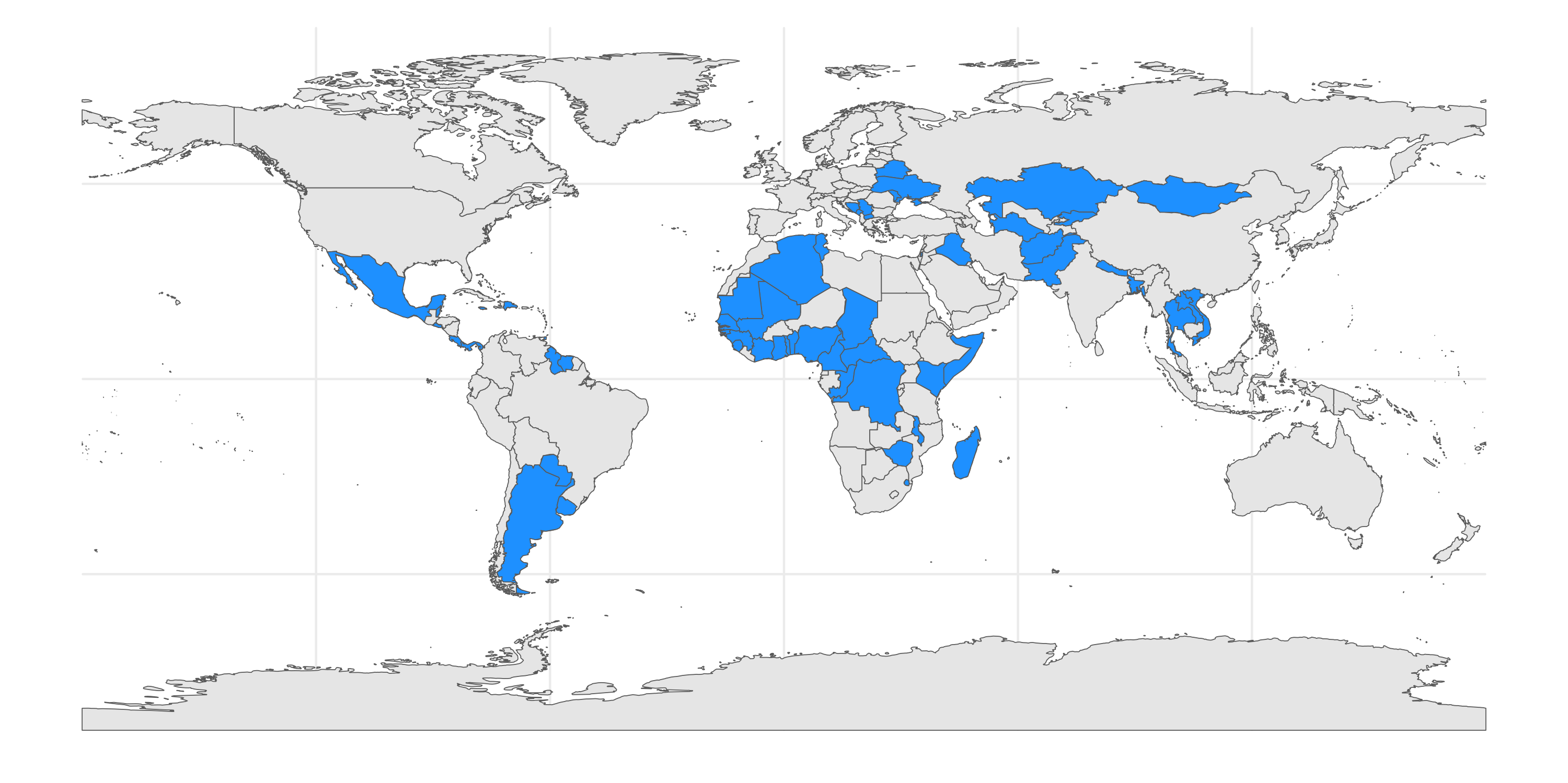
MICS data collected by UNICEF from Low and Middle Income Countries (LMIC) around the world. \(N = 224,632 \text{ families}; N_{countries} = 60\)

Countries in UNICEF MICS Data

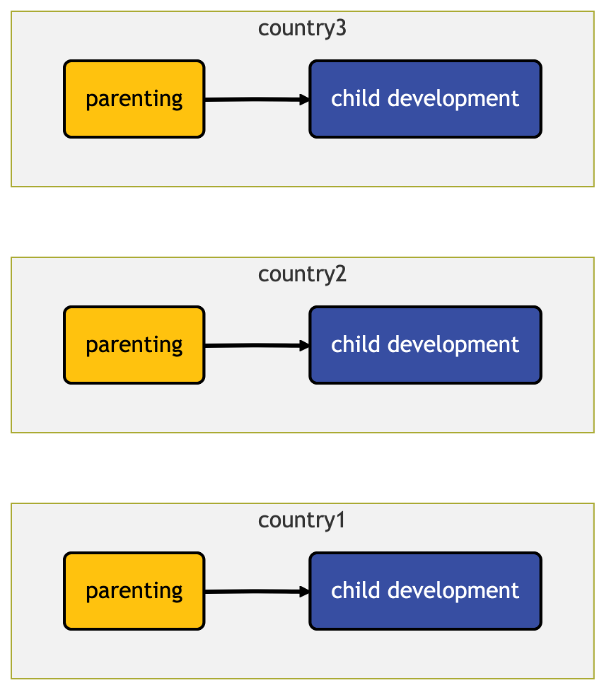
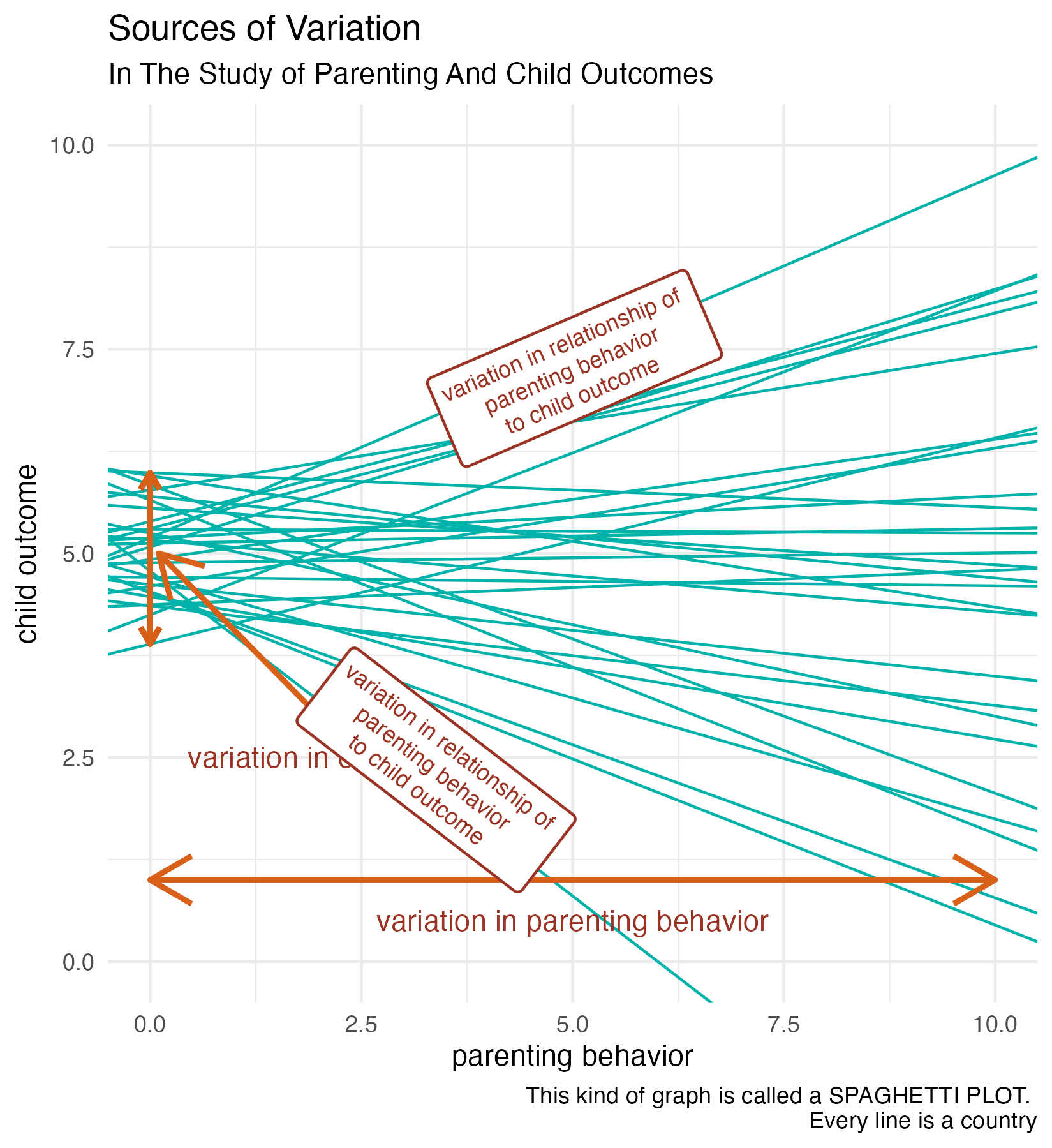
Sources of Variation In The Study of Parenting And Child Outcomes
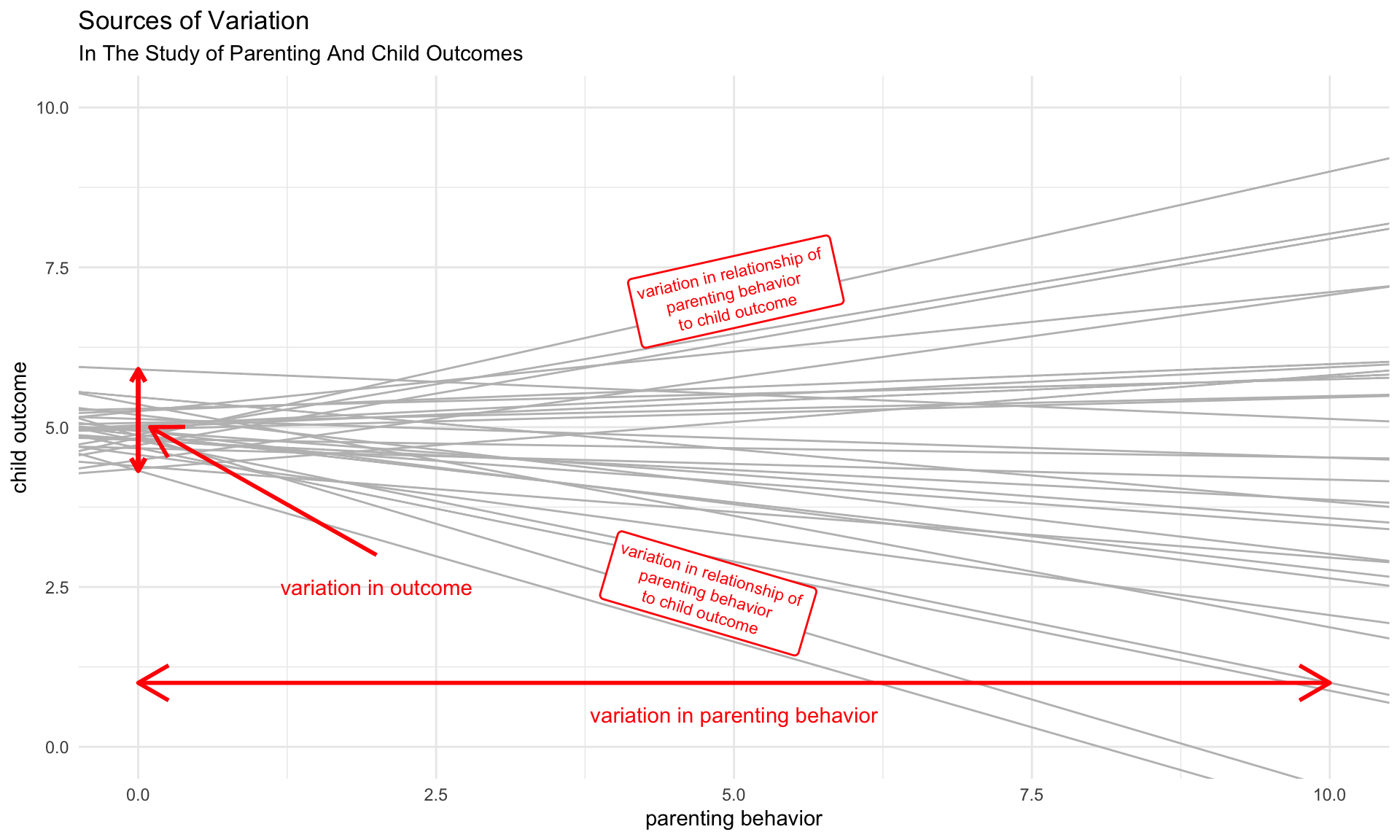
Figure 1: Sources of Variation In The Study of Parenting And Child Outcomes

The Equation

annotated equation

annotated equation

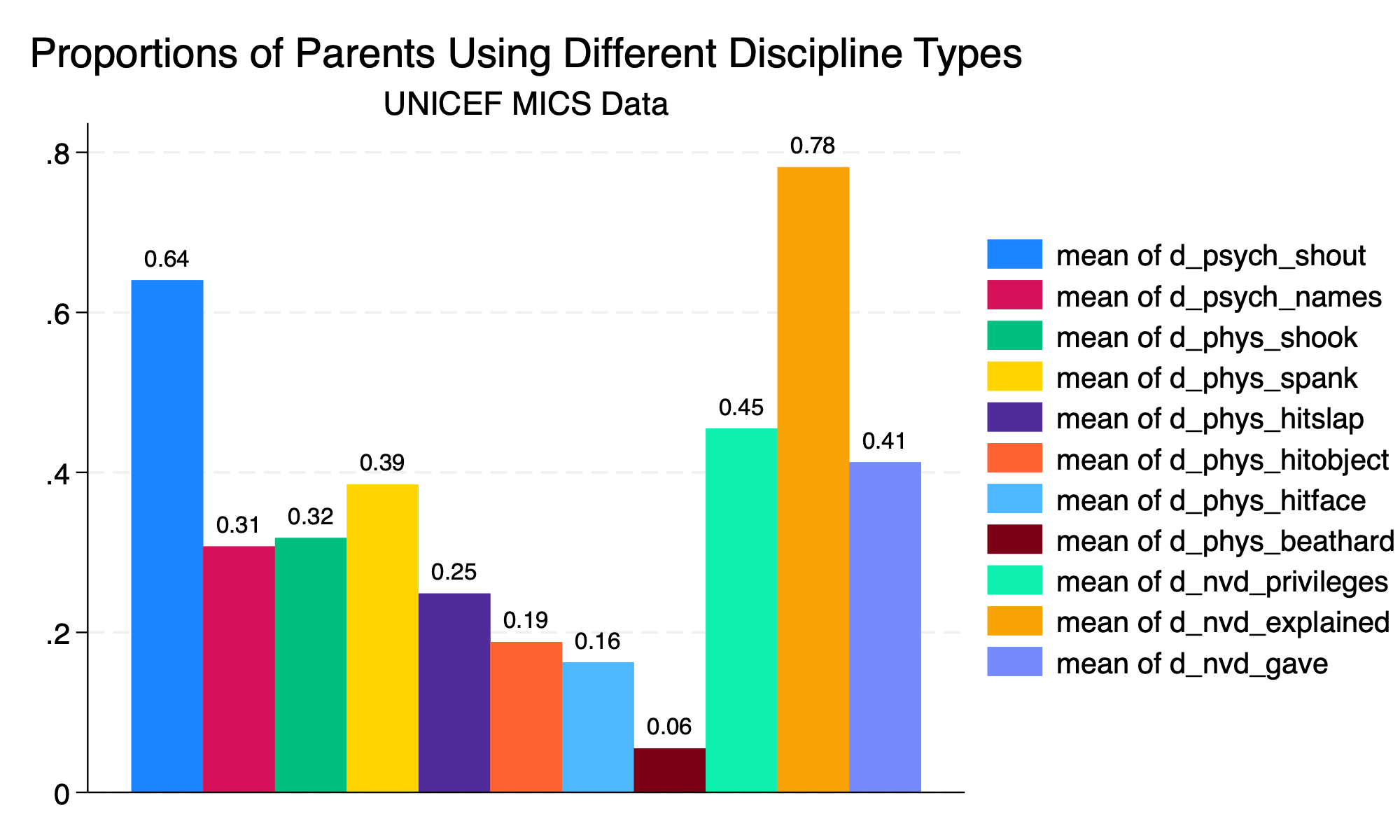
Parenting Behaviors Vary Somewhat Across Countries

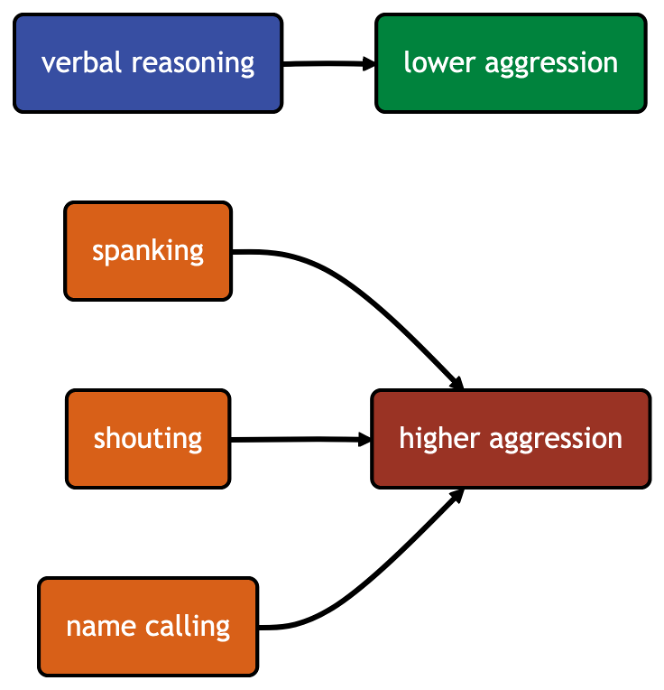
Verbal reasoning (78%) and shouting (64%) are the most common parental discipline behaviors toward young children.
The Maximal Model Approach

  • Hypothetically, one might imagine that there could be group level unobserved factors which affect many regression slopes–i.e. the relationship between multiple predictors (e.g. \(x_1\), \(x_2\), \(x_3\), etc.) and outcome variable \(y\).
  • Arguably, were one to ignore these unobserved factors in statistical estimation, they would show up either in an error term (\(e_i\) or \(u_0\)), or in the regression coefficients (\(\beta\)).
  • The above could lead to statistical bias and a substantive mis-estimation of important effects. Thus, there is a conceptual argument for including as many random effects—i.e. random slopes—in a statistical model as possible (Barr et al. 2013; Frank 2018).
  • There is also a substantive reason: We might be interested in the sizes of all the random slopes!

Relationship of Parenting And Child Outcomes

Maximal Model of Parenting and Child Aggression Outcome

aggress
child aggression
Sex of randomly selected child -0.023 **
Age of randomly selected child 0.000
Selected child shouted at 0.036 **
Selected child called dumb/lazy/names 0.054 **
Selected child shaken 0.039 **
Selected child spanked 0.023 **
Selected child hit/slapped on hand/arm/leg 0.033 **
Selected child hit with belt/brush/stick/etc 0.035 **
Selected child hit/slapped on face/head/ears 0.044 **
Selected child beat as hard as one could 0.026 **
Selected child’s privileges taken away 0.007
Selected child - explained why behavior wrong -0.014 *
Selected child given something else to do 0.004
Intercept 0.325 **
country
var(d_psych_shout) 0.001
var(d_psych_names) 0.001
var(d_phys_shook) 0.001
var(d_phys_spank) 0.001
var(d_phys_hitslap) 0.001
var(d_phys_hitobject) 0.001
var(d_phys_hitface) 0.002
var(d_phys_beathard) 0.002
var(d_nvd_privileges) 0.001
var(d_nvd_explained) 0.001
var(d_nvd_gave) 0.001
var(_cons) 0.012
Residual
var(e) 0.217
Number of observations 224632

** p<.01, * p<.05

The Relationship of Parenting And Child Outcomes Shows Little Variation Across Countries

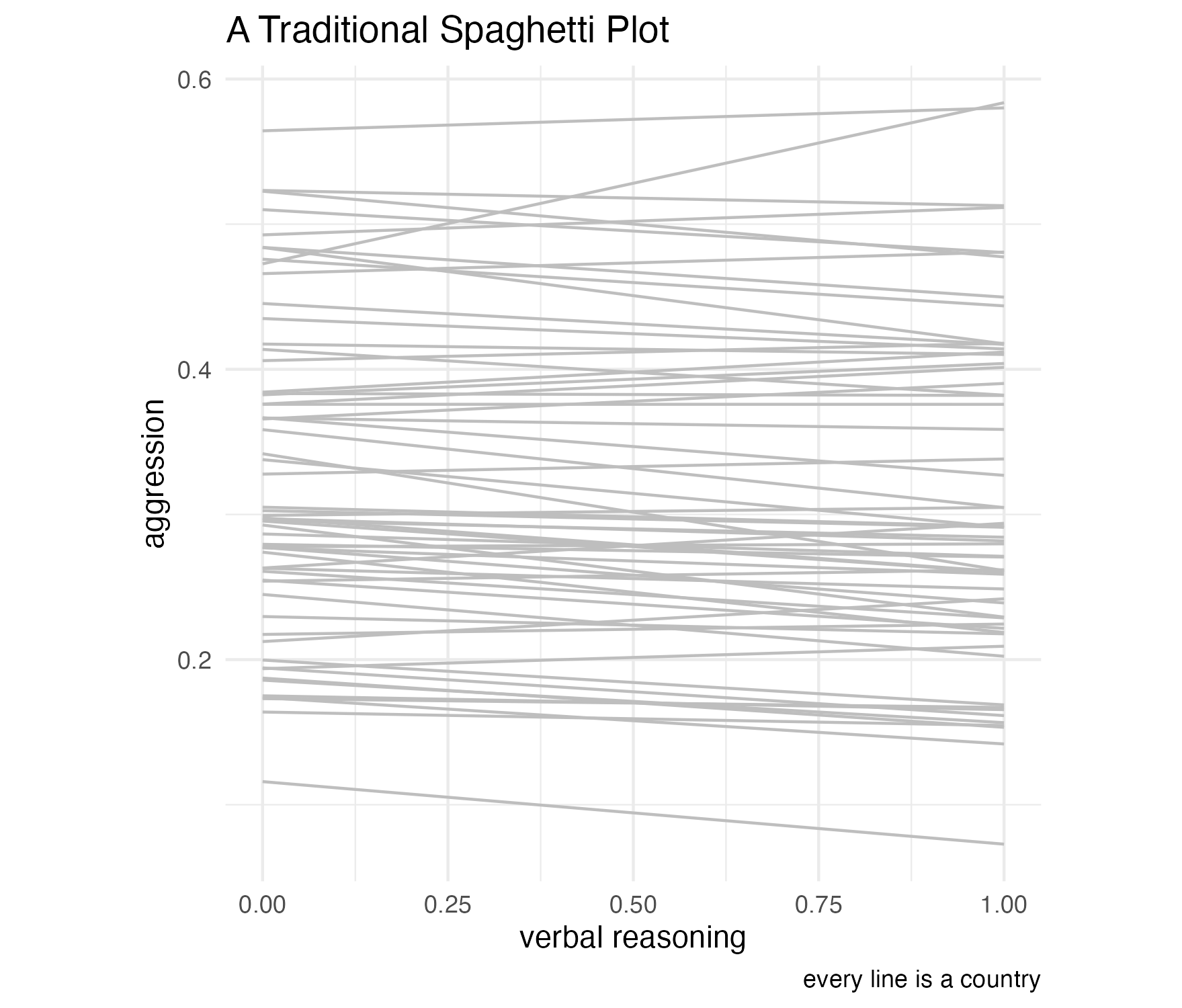
A Standard Spaghetti Plot

a standard ‘spaghetti’ plot

a standard ‘spaghetti’ plot

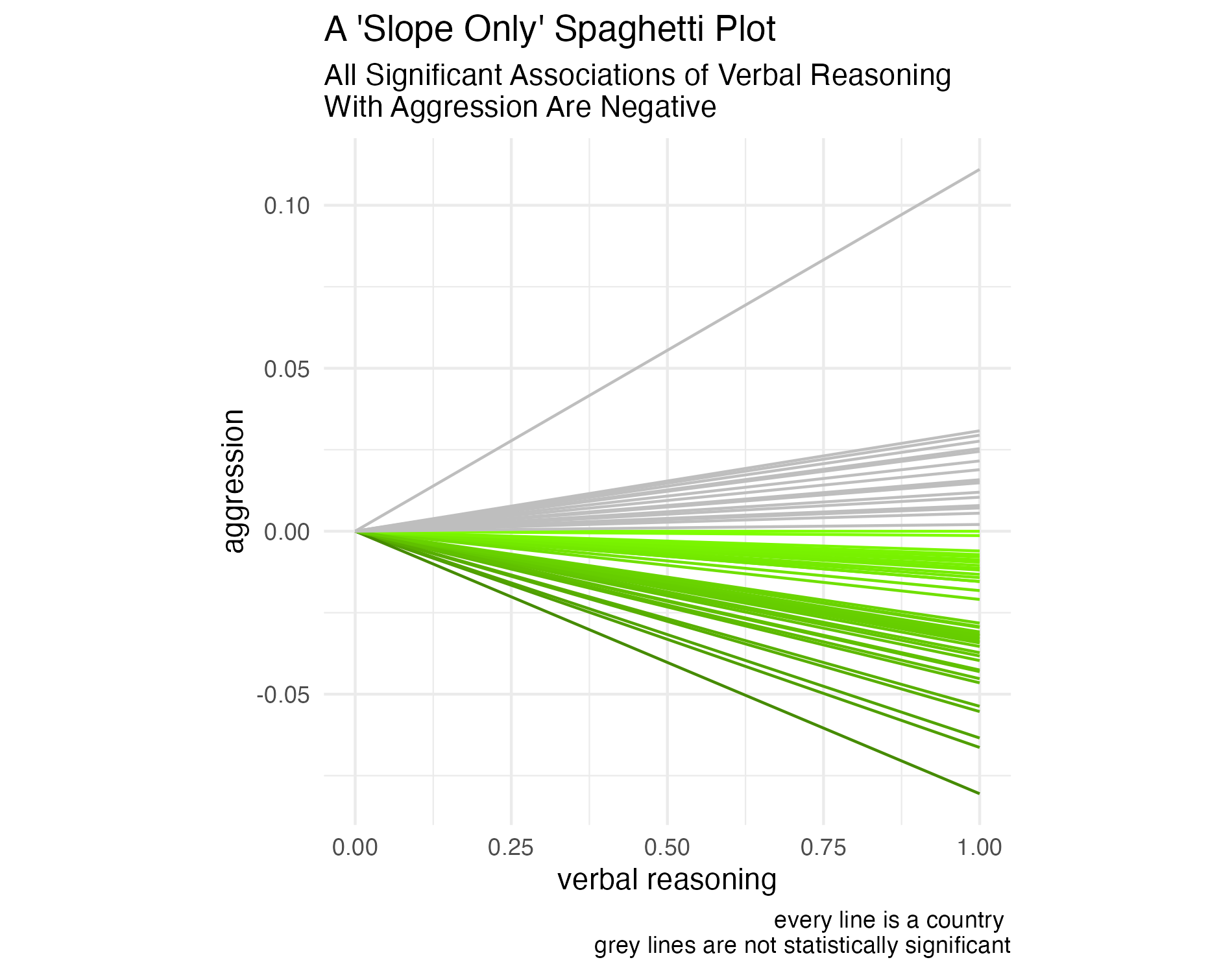
A Modified Spaghetti Plot

modified spaghetti plot

modified spaghetti plot

Quantifying Diversity and Commonality in the Relationship of Parenting To Child Outcomes

  1. Regression slopes–when statistically significant–are all in the same direction, and of at least somewhat similar magnitude.
  2. The actual values of the \(\text{var}(u_{kj})\) or \(\text{range}(u_{kj})\) are small.

The Argument Of This Presentation Revisited

  • Families, parents and children experience an incredible diversity of circumstances.
  • Parents engage in parenting behaviors with consequent diversity, though with some surprising similarities.
  • The associations of parenting with child outcomes are surprisingly consistent.
positive parenting

positive parenting

Implications

“My conception of the universal is that of a universal enriched by all that is particular, a universal enriched by every particular: the deepening and coexistence of all particulars.” (Césaire 1956)

  • Associations of parental discipline with child outcomes are very consistent across countries.
  • This may be helpful to international organizations (e.g. UNICEF, WHO) that are developing programs or interventions that are to be applied in multiple cultural settings.
  • While cultural tailoring will always be necessary to some degree; child development research can inform the foundations of widely applicable interventions.

Questions

Discussion

Global Families Project

Global Families Project

References

Antweiler, Christoph. 2016. Our Common Denominator: Human Universals Revisited. Berghahn.
Barr, Dale J., Roger Levy, Christoph Scheepers, and Harry J. Tily. 2013. “Random Effects Structure for Confirmatory Hypothesis Testing: Keep It Maximal.” Journal of Memory and Language 68 (3): 255–78. https://doi.org/10.1016/j.jml.2012.11.001.
Césaire, Aimé. 1956. “Letter to Maurice Thorez.” Présence Africaine.
Frank, Michael. 2018. Mixed Effects Models: Is It Time to Go Bayesian by Default? http://babieslearninglanguage.blogspot.com/2018/02/mixed-effects-models-is-it-time-to-go.html.
Gershoff, Elizabeth T., and Andrew Grogan-Kaylor. 2016. “Spanking and Child Outcomes: Old Controversies and New Meta-Analyses.” Journal of Family Psychology 30: 453–69. https://doi.org/10.1037/fam0000191.
Hanel, Paul H P, Gregory R Maio, and Antony S R Manstead. 2019. “A New Way to Look at the Data: Similarities Between Groups of People Are Large and Important.” Journal of Personality and Social Psychology 116 (April): 541–62. https://doi.org/10.1037/pspi0000154.
Hunt-Hendrix, Leah, and Astra Taylor. 2024. Solidarity: The Past, Present, and Future of a World-Changing Idea. Pantheon Books,.
UNICEF. 2024a. FAST FACTS: Violence Against Children Widespread, Affecting Millions Globally. https://www.unicef.org/press-releases/fast-facts-violence-against-children-widespread-affecting-millions-globally.
UNICEF. 2024b. “Not the New Normal” – 2024 ’One of the Worst Years in UNICEF’s History’ for Children in Conflict. https://www.unicef.org/press-releases/not-new-normal-2024-one-worst-years-unicefs-history-children-conflict.
Ward, Kaitlin P., Andrew C. Grogan-Kaylor, Julie Ma, Garrett Pace, and Shawna J. Lee. 2023. “Associations Between 11 Parental Discipline Behaviors and Child Outcomes Across 60 Countries.” BMJ Open, ahead of print. https://doi.org/10.1136/bmjopen-2021-058439.