Toward Childhoods Free From Violence

50 Years of Research Tells Us to End Corporal Punishment

2026-07-06

Acknowledgments

  • Professor Julie Ma
  • Professor Shawna Lee
  • Professor Liz Gershoff
  • Professor Emerita Joan Durant
  • Nadine Block
  • Professors Jorge Cuartas
  • Professor Dana McCoy

What this talk is about.

  • “Physical Discipline”
  • “Corporal Punishment”
  • “Spanking”

All of these are roughly synonymous. They are widely used forms of discipline worldwide.

There is a lot of research evidence around the use of spanking or physical punishment, but family decisions about whether to use physical punishment are often considered to be a personal matter.

Outline of the Talk

  • Trends in the research.
  • All of this conversation is nested in a global conversation.
  • I would like to end, where we should always end a discussion of these issues, with a discussion of positive parenting. What can parents do in these situations?

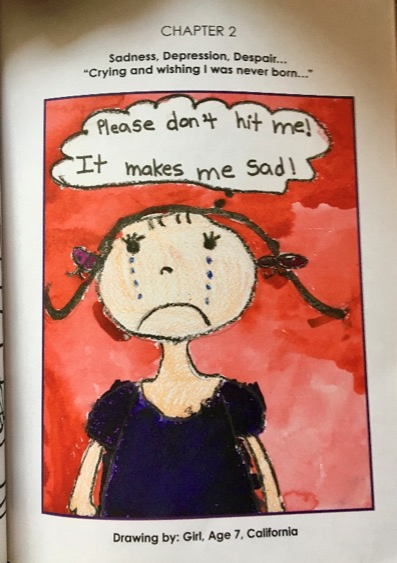
How Spanking Feels to Children

Nadine Block, Center for Effective Discipline
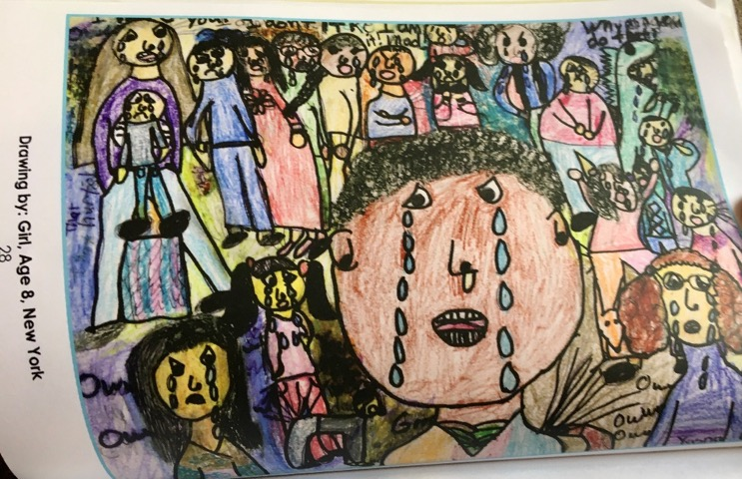
image from Nadine Block

image from Nadine Block

Meta-Analysis of 50 Years of Research on Corporal Punishment

  • Gershoff & Grogan-Kaylor (2016)
  • Study of studies
  • We screened 1,574 articles
  • 50 years of research
  • 111 unique “effect sizes” (study results)
  • 160,927 children
  • Remarkably consistent results. “There is no debate.”
  • 13 of 17 outcomes displayed statistically significant negative (undesirable results).
  • For no outcome was there a benefit of spanking.
  • Only 1 study showed a statistically significant benefit of spanking.

Meta-Analytic Results

Thinking More Critically About the Size of Effects

Joan Lipuscek has written a really nice blog post thinking through some of the issues raised by our research. In particular, she thinks very critically about the sizes of effects.
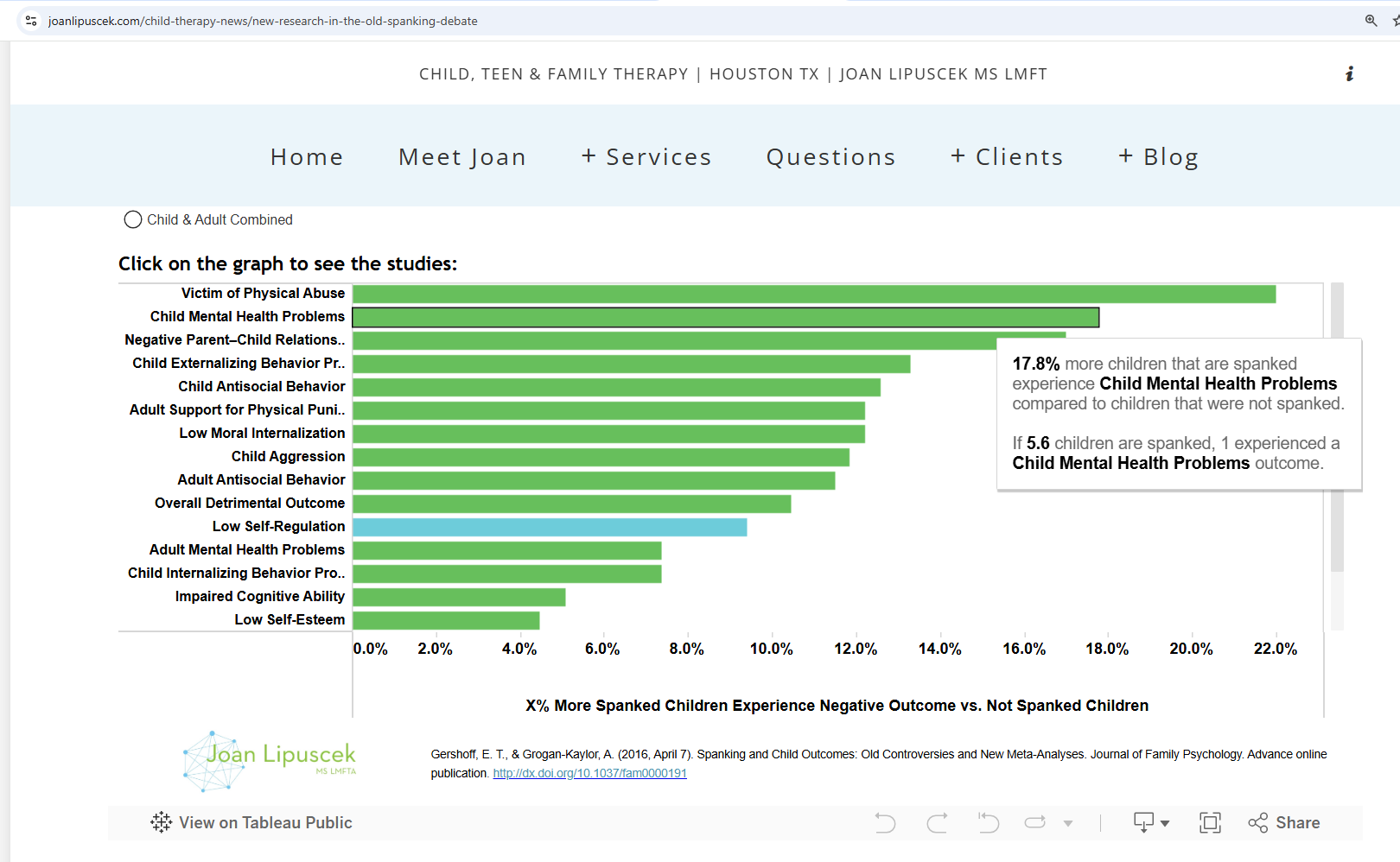
blog post from Joan Lipuscek

Response to Meta-Analysis
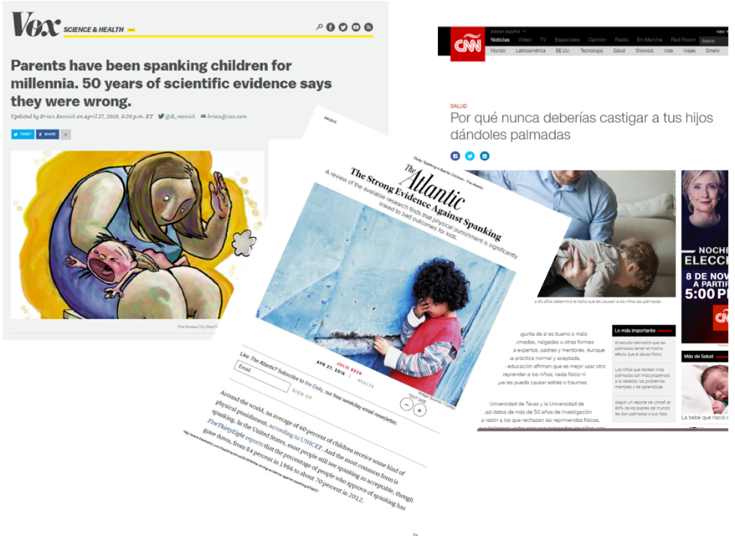
responses to meta-analysis

  • Over 100 mentions in English language news media.
  • University of Michigan News indicates that the press release from UM News received “more than 100 hits in Spanish, 60 in Chinese, 43 in Portuguese and 23 in India.”

Impact

  • Policy Statement by American Academy of Pediatrics
  • Policy Statement by American Psychological Association
  • More recent work has resulted in oral testimony by colleague before First Commission of the Congress of Colombia

Global Research on Corporal Punishment

Locations of Countries in UNICEF MICS Data

e.g. Pace et al. (2019), Ward et al. (2022), Ward et al. (2023)

A Cascade of Bans on Corporal Punishment

What Can Parents Do?

  • Parenting is a “long game,” rather than a “short game”. Growing rigorous evidence that ongoing love and support are the strongest shapers of positive behavior.
  • Well studied in the U.S.
  • Growing attention in global research.
  • “Catch children being good”. Praise.
  • Age appropriate removal of privileges.
  • Spend time with children.
  • Let children know you love them.
  • Listen to children. Think about where children are in terms of their developmental tasks.
  • https://resourcecentre.savethechildren.net/library/positive-discipline-everyday-parenting-pdep-fourth-edition

Questions?

References

Gershoff, E. T., & Grogan-Kaylor, A. (2016). Spanking and child outcomes: Old controversies and new meta-analyses. Journal of Family Psychology, 30, 453–469. https://doi.org/10.1037/fam0000191
Pace, G. T., Lee, S. J., & Grogan-Kaylor, A. (2019). Spanking and young children’s socioemotional development in low- and middle-income countries. Child Abuse and Neglect, 88, 84–95. https://doi.org/10.1016/j.chiabu.2018.11.003
Ward, K. P., Grogan-Kaylor, A. C., Ma, J., Pace, G., & Lee, S. J. (2023). Associations between 11 parental discipline behaviors and child outcomes across 60 countries. BMJ Open. https://doi.org/10.1136/bmjopen-2021-058439
Ward, K. P., Lee, S. J., Grogan-Kaylor, A. C., Ma, J., & Pace, G. T. (2022). Patterns of caregiver aggressive and nonaggressive discipline toward young children in low- and middle-income countries: A latent class approach. Child Abuse & Neglect, 128. https://doi.org/https://doi.org/10.1016/j.chiabu.2022.105606