flowchart LR

  subgraph childhood

  m("maltreatment")

  end

  subgraph adolescence

  e("empathy")

  end

  subgraph adulthood

  sh("self harm thoughts")

  end

  m --> sh

  e --> sh

  childhood ~~~ adolescence

  adolescence ~~~ adulthood

  style m fill:#9A3324,stroke:#000000,stroke-width:2px,color:#FFFFFF;

  style e fill:#374EA2,stroke:#000000,stroke-width:2px,color:#FFFFFF;

  style sh fill:#FFC20E,stroke:#000000,stroke-width:2px,color:#000000;

  style childhood fill:#D9D9D9,stroke:#000000,stroke-width:2px,color:#000000;

  style adolescence fill:#D9D9D9,stroke:#000000,stroke-width:2px,color:#000000;

  style adulthood fill:#D9D9D9,stroke:#000000,stroke-width:2px,color:#000000;

  linkStyle 0,1 stroke:#000000,stroke-width:3px,font-size:36px,color:black;
When Empathy Helps and Hurts
Non-Linear Associations Between Early Childhood Maltreatment History, Empathy and Self-Harm Thoughts
Scroll down to explore ↓
⬇️
Objective
Child maltreatment is a well-established risk factor for self-harm, yet the affective processes underlying this association remain unclear.
This study (Hong et al., 2026) examines how empathy relates to the association between early childhood maltreatment and lifetime self-harm thoughts.
Method
Data from 303 adults were stratified based on the presence or absence of maltreatment history in early childhood. Self-reports of lifetime self-harm thoughts in adulthood and empathy during adolescence were examined in both groups using generalized additive models (Wood, 2017, 2025) to assess non-linear relationships. Models also controlled for respondents’ age, gender, and socio-economic status.
Results
There was an interesting and complex pattern of results.
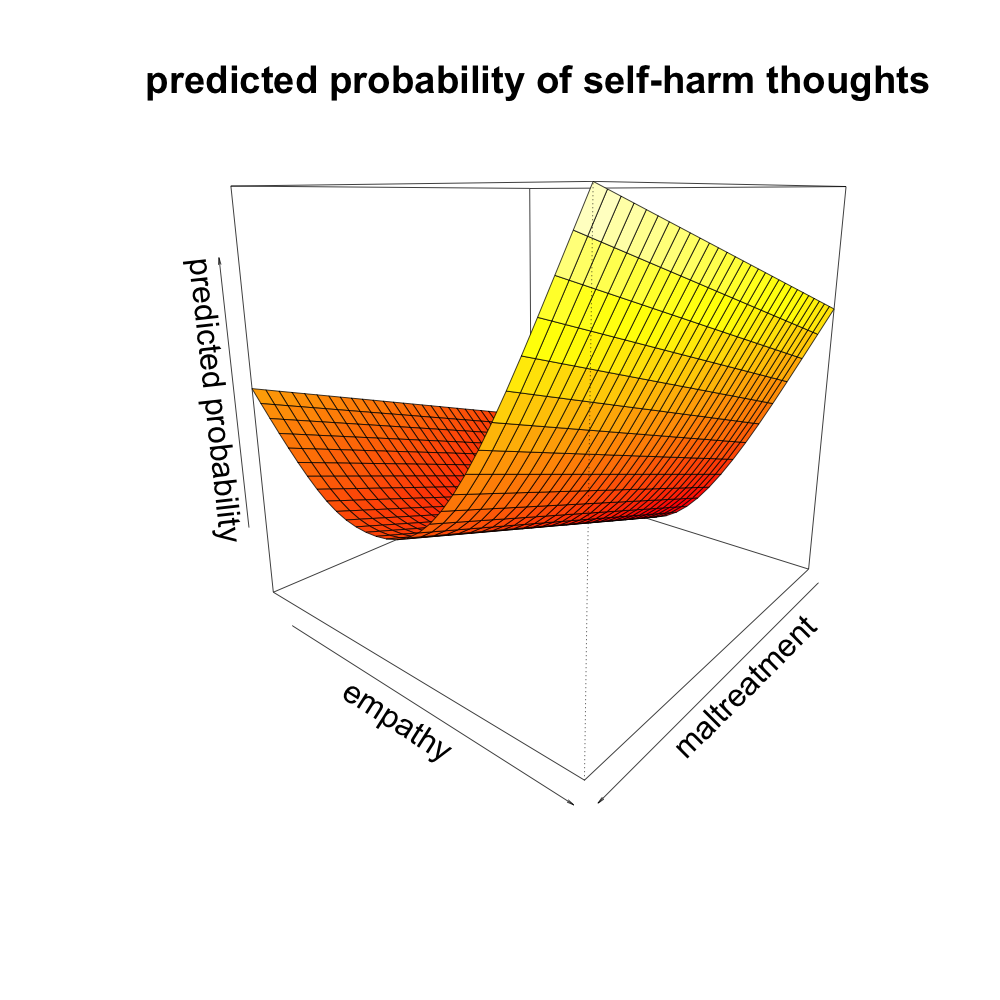
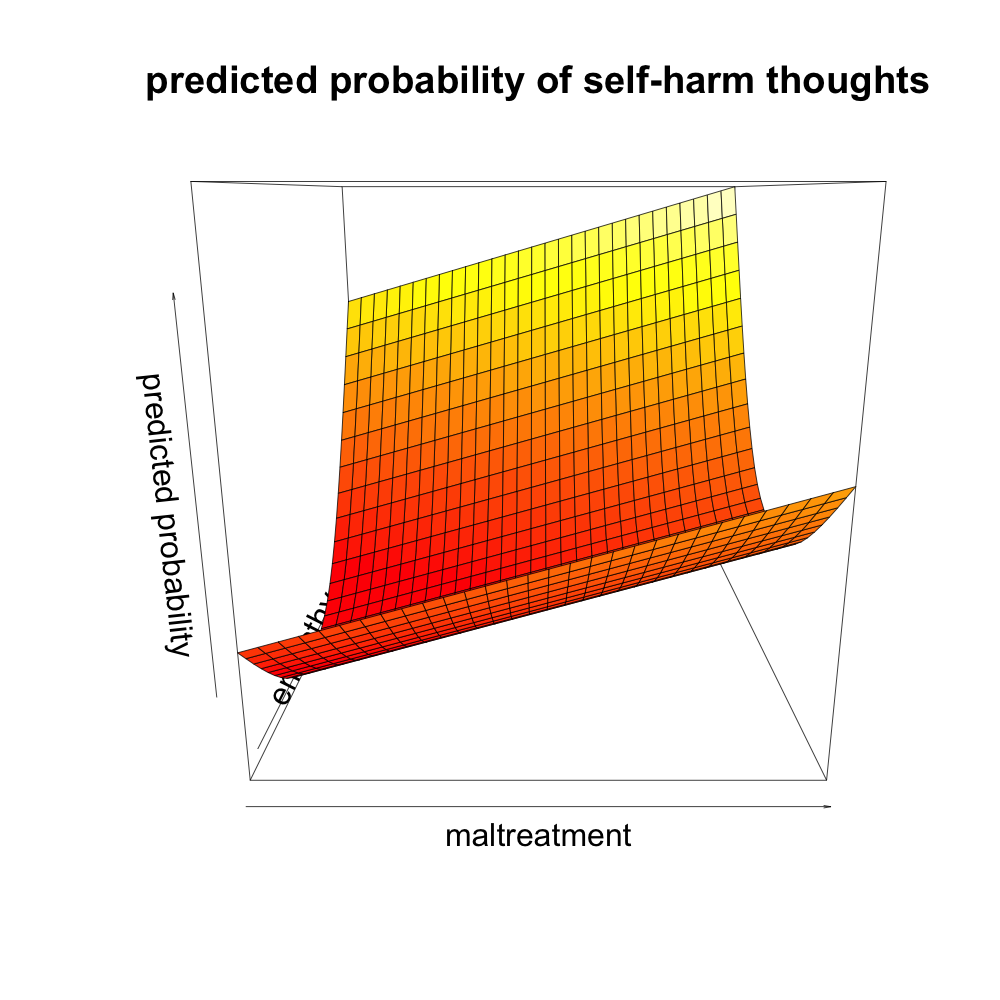
Adults with early childhood maltreatment history were more likely to report self-harm thoughts than those without such a history.
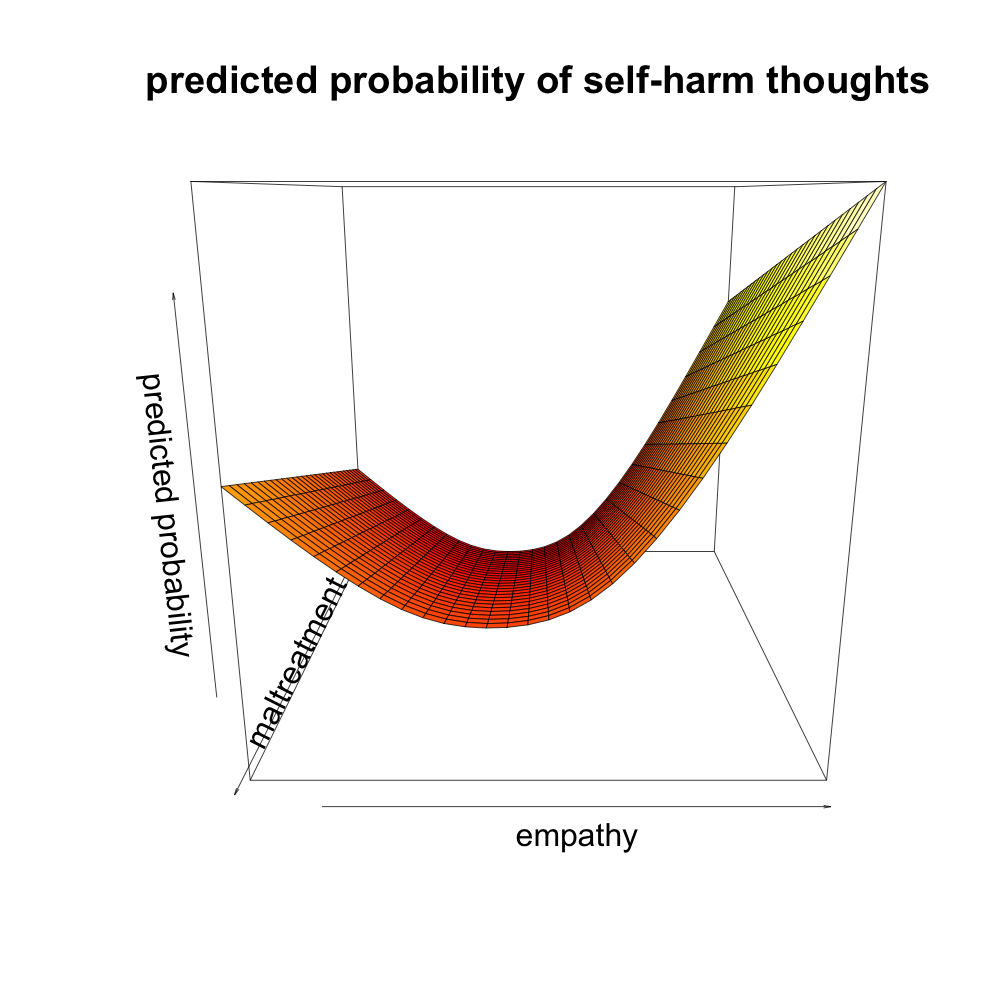
A significant nonlinear association was observed between empathy and self-harm thoughts.
Predicted probabilities of self-harm thoughts were lowest at moderate levels of empathy for both groups.
Risk for self-harm thoughts was highest among individuals with high empathy.
Risk for self-harm thoughts was also somewhat high for individuals with low empathy.
Conclusion
While a moderate level of empathy can be protective from early childhood maltreatment, both low and high levels of empathy were associated with a greater risk for self-harm thoughts.
Findings suggest the need to further investigate the role of empathy as a “risky strength” among adults.
Future Research
While the temporal ordering of the variables in this study supports the idea of empathy as a “risky strength”, reverse causality is also a possibility. It may be that different levels of empathy are an outcome of different levels of self-harm thoughts. Future research would do well to explore these questions with larger samples, especially those that have repeated measures of the constructs of interest, and advanced quantitative methods capable of offering more causally robust conclusions.
flowchart TB

  subgraph maltreatment

  direction LR

  e1("empathy") --> sh1("self harm thoughts")

  end

  subgraph nomaltreatment ["no maltreatment"]

  direction LR

  e0("empathy") --> sh0("self harm thoughts")

  end

  style e0 fill:#374EA2,stroke:#000000,stroke-width:2px,color:#FFFFFF;

  style e1 fill:#374EA2,stroke:#000000,stroke-width:2px,color:#FFFFFF;

  style sh0 fill:#FFC20E,stroke:#000000,stroke-width:2px,color:#000000;

  style sh1 fill:#FFC20E,stroke:#000000,stroke-width:2px,color:#000000;

  style maltreatment fill:#9A3324,stroke:#000000,stroke-width:2px,color:#FFFFFF;

  style nomaltreatment fill:#D9D9D9,stroke:#000000,stroke-width:2px,color:#000000;

  linkStyle 0,1 stroke:#000000,stroke-width:3px,font-size:36px,color:black;
References
Hong, S., Grogan-Kaylor, A., Kim, M., Bender, A. E., Saba, S., Yu, C.-L., Fedina, L., & Herrenkohl, T. I. (2026). When empathy helps and hurts: Non-linear associations between early childhood maltreatment history, empathy and self-harm thoughts. Child Maltreatment. https://doi.org/10.1177/10775595261422448
Wood, S. N. (2017). Generalized additive models: An introduction with R (Second edition.). CRC Press, Taylor & Francis Group.
Wood, S. N. (2025). Generalized additive models. Annual Review of Statistics and Its Application, 12, 497–526. https://doi.org/10.1146/annurev-statistics-112723-034249