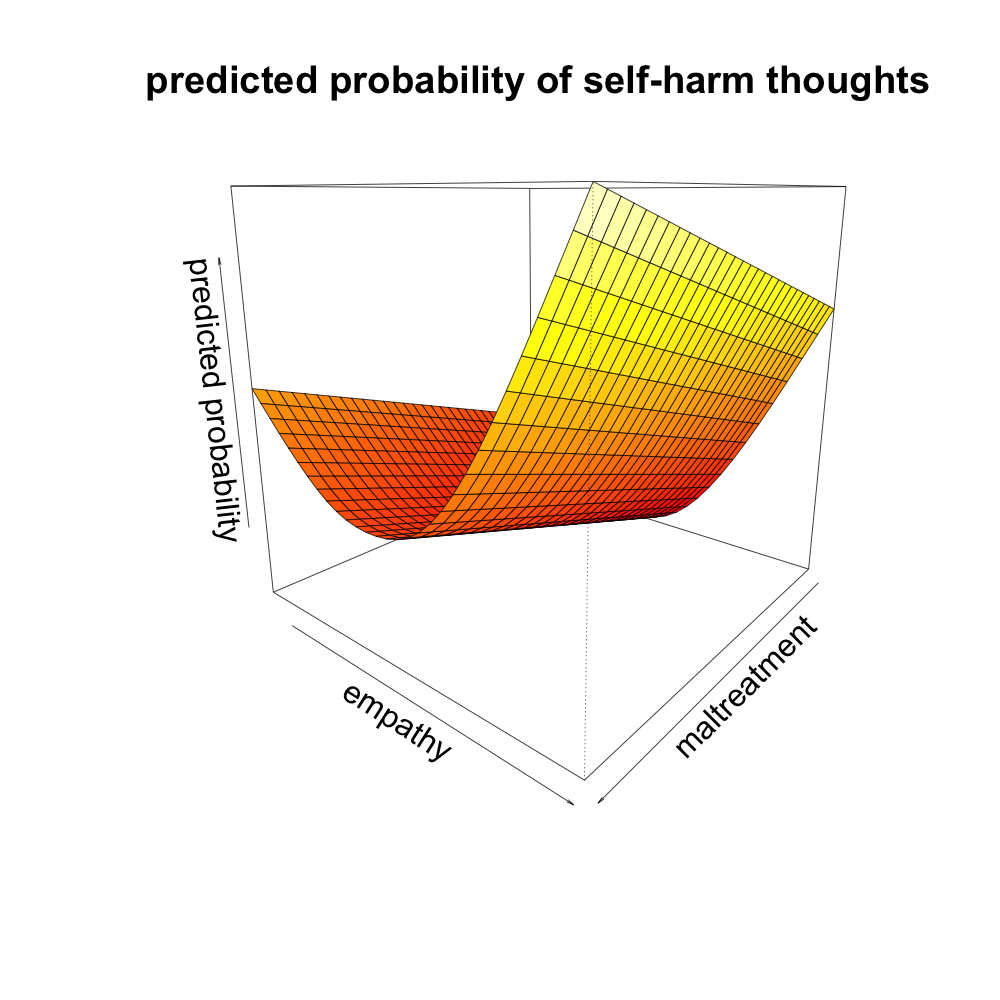
We’ve published a new paper on empathy and mental health outcomes (Hong et al., 2026). The paper uses generalized additive models (Wood, 2017, 2025) to examine non-linear relationships between empathy and self-harm, and provides evidence that empathy may be a “risky strength”. Too much or too little empathy is associated with higher levels of self-harm thoughts, while a moderate amount of empathy is associated with lower levels of self-harm thoughts.
A scrollytelling summary of the paper is available here: https://agrogan1.github.io/closeread/empathy/empathy.html
References
Hong, S., Grogan-Kaylor, A., Kim, M., Bender, A. E., Saba, S., Yu, C.-L., Fedina, L., & Herrenkohl, T. I. (2026). When empathy helps and hurts: Non-linear associations between early childhood maltreatment history, empathy and self-harm thoughts. Child Maltreatment. https://doi.org/10.1177/10775595261422448
Wood, S. N. (2017). Generalized additive models: An introduction with R (Second edition.). CRC Press, Taylor & Francis Group.
Wood, S. N. (2025). Generalized additive models. Annual Review of Statistics and Its Application, 12, 497–526. https://doi.org/10.1146/annurev-statistics-112723-034249